AC Capacitor Replacement Cost in 2026: A $20 Part, A $300 Bill, and Why That Is Fair
Quick answer: A residential AC capacitor replacement runs $200 to $400 for parts and labor combined in 2026. The capacitor itself costs $15 to $40 wholesale or $30 to $60 retail. The gap is not a ripoff: the difference covers diagnosis, the safe discharge of stored electrical energy that can injure or kill, licensed labor, and a service warranty.
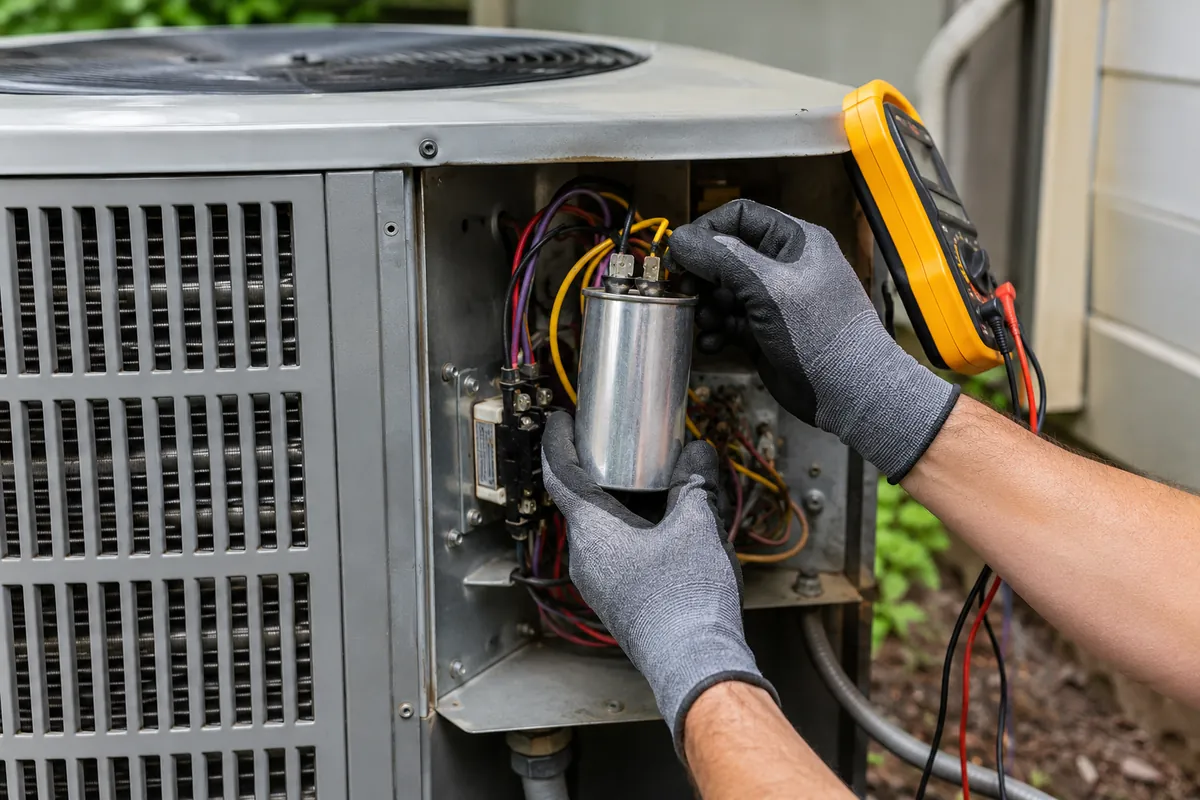
The phone calls I used to take as a warranty adjuster about AC capacitor failures fell into two categories. The first was the homeowner who had paid $250 and was angry because they had searched the part number on Amazon and found it for $19. The second was the homeowner who had paid $720 and was angry because the unit failed again three weeks later. Both calls were predictable, and both came down to the same gap in understanding about what a capacitor replacement actually involves.
Here is what the part costs, what the labor costs, what a fair quote looks like in 2026, and the symptoms that tell you the capacitor is about to fail before the unit dies.
The honest cost range in 2026
| Cost component or scenario | 2026 typical cost | What it covers / notes |
|---|---|---|
| Dual-run capacitor, the part at wholesale | $15 to $40 | What a supply house charges a tech |
| Dual-run capacitor, the part at retail | $30 to $60 | Online or counter price to a homeowner |
| Diagnostic / service-call fee | $75 to $125 | Often credited toward the repair |
| Installation labor | $80 to $180 | Discharge, swap, verify cycle, warranty |
| Typical all-in (parts + labor) | $185 to $400 | Includes a 90-day to 1-year labor warranty |
| Flat-rate "capacitor special" | $300 to $600 | Bundles the part; scrutinize the high end |
| Low-volume cost markets (Phoenix, Houston, Atlanta) | $180 to $280 | High year-round call volume, fierce competition |
| High-cost markets (Boston, Seattle, Minneapolis) | $280 to $420 | Premium licensed labor, seasonal demand |
| Emergency / after-hours premium | add ~15% to 25% | Weekend, holiday, or peak-summer dispatch |
*Ranges reflect 2026 U.S. service pricing for a residential dual-run capacitor; component heat-degradation context per the U.S. Department of Energy. Market figures cross-checked against 2026 cost data from This Old House and HomeGuide. Pricing varies by market and unit; confirm current pricing with a written local estimate.
A residential AC capacitor replacement runs $200 to $400 for parts and labor combined this year. The part itself, the dual-run capacitor that lives in the outdoor condenser unit, costs $15 to $40 at wholesale and $30 to $60 at retail. The labor and overhead make up the rest.
That ratio sounds bad until you understand what the labor includes. A licensed HVAC tech needs to be dispatched, drive to the property, diagnose the failure (not always obvious), discharge the old capacitor safely (which carries a real electrical risk to anyone who does not know how), install the replacement, verify the unit cycles correctly, and stand behind the work with a warranty. The $200 to $400 figure includes a 90-day to 1-year labor warranty in most service agreements.
The geographic variation: Phoenix, Houston, and Atlanta tend toward the lower end ($180 to $280) because HVAC call volume is high year-round and competition is fierce. Boston, Seattle, and Minneapolis tend higher ($280 to $420) because licensed HVAC labor commands a premium and the call volume is more seasonal. Rural markets vary either direction depending on the local labor pool.
What a capacitor actually does
A capacitor stores electrical energy and releases it in a controlled burst when the AC compressor or condenser fan motor starts. Residential central AC units typically have a single dual-run capacitor that handles both the compressor and the fan, identified by three terminals labeled Common, Fan, and Herm.
When a capacitor fails, the motor it serves cannot start, or starts hesitantly, or starts and then trips a breaker. The unit usually still has power, the thermostat still calls for cooling, but the outdoor unit hums and clicks and never spins up. Inside the house, the indoor blower may run, pushing room-temperature air through the vents. The homeowner notices the warm air first, then the noise from outside.
The failure pattern clusters around year 7 to year 10 of unit life, with a secondary peak in years 12 to 15 as the unit ages out. Heat acceleration is the dominant cause. Units in direct afternoon sun fail capacitors faster than shaded units. Units in attics where ambient temperatures cross 130 degrees fail fastest of all.
The 60-second diagnostic test
An HVAC tech with a multimeter can confirm capacitor failure in under a minute. The test measures microfarads (uF), the unit of capacitance. A healthy capacitor reads within plus or minus 6 percent of its rated value. A 45/5 uF dual-run capacitor reads 42.3 to 47.7 on the compressor side and 4.7 to 5.3 on the fan side when healthy.
A failing capacitor reads low or zero. A bulged or leaking capacitor is dead on visual inspection alone, no meter required. The casing swells, the top dome distorts, or oil seeps from the seal. Any of those visual signs means the capacitor is replaced today.
Asking the technician to show you the meter reading on the new capacitor after install is a reasonable request. The reading should match the printed rating within tolerance. This is also how you verify the technician actually installed a new part rather than reusing the old one in a scenario nobody likes to talk about.
Why DIY is not advised
A capacitor stores electrical energy even after the power is disconnected. A run capacitor in a 240V residential AC system stores enough energy to seriously injure or kill a human. The discharge procedure involves shorting the terminals across a resistor or a screwdriver shaft wrapped in insulation. Done wrong, the result is a violent electrical arc.
YouTube tutorials exist. The comments on those tutorials include people who got hurt. The $15 part is real. The skill required to install it safely is real. The math on the $200 to $400 service call begins to make sense when the alternative is an emergency room visit or worse.
There is also a warranty consideration. Most manufacturer warranties on residential AC systems require service work to be performed by licensed HVAC contractors. A homeowner who replaces their own capacitor and triggers a downstream failure may face a denied warranty claim later. The savings on the capacitor install does not justify voiding the unit's coverage.
> If your AC is humming and not cooling, do not start tearing the unit apart. Local HVAC Advisor can match you with a licensed technician in your zip code, often same day during summer.
The symptoms before the unit dies completely
A capacitor rarely fails without warning. The symptoms in the weeks before complete failure include:
- The outdoor unit takes longer than usual to start when the thermostat calls for cooling. Healthy startup is a one-second delay between the click of the contactor and the spin-up of the fan. Failing capacitors push that delay to 3 to 8 seconds.
- A persistent low hum from the outdoor unit when it should be running. The hum is the motor attempting to start without sufficient capacitor assistance.
- Intermittent cooling cycles. The unit cools normally for an hour, then stops, then resumes 30 minutes later. The capacitor is degrading but not yet dead.
- A visible bulge or oil residue on the capacitor case. This is the terminal stage. The capacitor will fail within days.
Catching a capacitor at the symptom stage rather than the dead stage saves money in three ways: the service call is not emergency rate, the technician has time to inspect other components for related wear, and the homeowner avoids the discomfort of a day or two without cooling.
When the cost crosses into "replace the unit"
A capacitor replacement is the cheapest common HVAC repair. It is rarely a reason on its own to replace the entire system. But on a unit that is 12 to 15 years old, the capacitor failure is often the first of a series of failures. The questions to ask the technician at the capacitor service call:
- What is the visual condition of the compressor terminals and wiring? Burnt or discolored terminals are warning signs.
- What is the refrigerant pressure on both sides? Pressures outside the expected range indicate a leak or compressor wear.
- What does the contactor look like? Pitted or burnt contacts mean it is months from failure.
- What is the visual condition of the condenser coils? Corroded or fin-bent coils reduce efficiency and indicate the unit's age is catching up.
If three of those four answers come back concerning, the capacitor replacement is a stopgap. The full system replacement conversation starts now, before the next 90 degree week.
The warranty layer
Many home warranty contracts cover capacitor replacement, typically with a service fee of $75 to $125 and full coverage of parts and labor beyond that. A homeowner with a $100 service fee on a warranty plan pays $100 for a repair that would have run $300 without coverage. The savings on a single capacitor service does not justify a $600 annual warranty premium, but the warranty value compounds across all the other small repairs.
The pre-existing condition clause matters here. A capacitor that was already failing at the warranty contract effective date is denied as pre-existing. The first capacitor service call after a new warranty often produces a denial unless the homeowner can document the unit was in working order at signing. The home inspection report from the property purchase, or a maintenance receipt from before the warranty effective date, settles most of these disputes in the homeowner's favor.
The numbers on a real quote
A fair AC capacitor replacement quote in 2026 looks like this:
- Diagnostic / service call fee: $75 to $125
- Capacitor part: $30 to $60
- Installation labor: $80 to $180
- Total: $185 to $365
Quotes above $400 for a straightforward capacitor swap deserve a second opinion unless the technician is also addressing additional failures uncovered during the service call. Quotes below $150 deserve scrutiny too, because the technician may be cutting corners on diagnostic time or part quality.
> Get a written quote before authorizing work. Local HVAC Advisor connects homeowners with vetted local technicians who provide written estimates before work begins.
Frequently Asked Questions
How much does it cost to replace an AC capacitor in 2026?
A residential AC capacitor replacement runs $200 to $400 for parts and labor combined this year. A fair itemized quote breaks down to a $75 to $125 diagnostic fee, a $30 to $60 part, and $80 to $180 in installation labor, totaling roughly $185 to $365. Quotes above $400 for a straightforward swap deserve a second opinion.
Why does a $20 capacitor cost $300 to install?
The part is cheap but the work is not. The price covers a licensed tech dispatched to your home, the diagnosis, the safe discharge of a component that stores enough energy to seriously injure or kill, the install, a verification that the unit cycles correctly, and a service warranty. The U.S. Department of Energy notes that AC components like capacitors degrade with heat over time, which is why professional handling matters.
What are the signs of a failing AC capacitor?
The outdoor unit takes longer than usual to start (a healthy one-second delay stretches to 3 to 8 seconds), a persistent low hum when the unit should be running, intermittent cooling cycles, or a visible bulge and oil residue on the capacitor case. The bulge or oil leak is the terminal stage and means failure within days.
Can I replace an AC capacitor myself?
It is not advised. A run capacitor in a 240V system stores enough energy to seriously injure or kill even after power is disconnected, and an incorrect discharge produces a violent electrical arc. DIY work can also void the unit's manufacturer warranty, which usually requires licensed service. The savings on a $15 part does not justify the risk.
Does a home warranty cover AC capacitor replacement?
Many home warranty contracts do, typically with a service fee of $75 to $125 and full coverage of parts and labor beyond that. The pre-existing condition clause matters: a capacitor already failing at the contract effective date can be denied, so keep a maintenance receipt or home inspection report showing the unit was in working order at signing.
The closer
A $300 bill for a $20 part is not a ripoff when the $280 difference covers diagnosis, safe handling of stored electrical energy, licensed labor, a service warranty, and the assurance that the next failure is not yours alone to figure out. The homeowner who understands the math walks into the service call ready to accept a fair quote and reject an unfair one. The homeowner who does not, pays either too much or too little, and one of those is worse than the other.
The right move when the unit hums and refuses to start: shut off power at the disconnect, do not open the panel, and call for a licensed tech. The wrong move: a YouTube tutorial, a $15 part from Amazon, and a story for the emergency room intake nurse.
> If you need a diagnostic this week, start here. Local HVAC Advisor matches homeowners with licensed local technicians. Same-day appointments are common during the summer peak.