Central AC Installation Cost in 2026: The Six Line Items Contractors Hide
Quick answer: A central air conditioning installation runs $5,500 to $9,000 all-in for a typical single-family home in 2026, with an in-kind 3-ton 14 SEER replacement landing around $6,400 to $6,900. The wide spread is rarely dishonesty. It is six line items most quotes bundle or hide: equipment, labor, permits and code work, refrigerant line set, electrical, and removal. Get three itemized written bids and compare line by line.
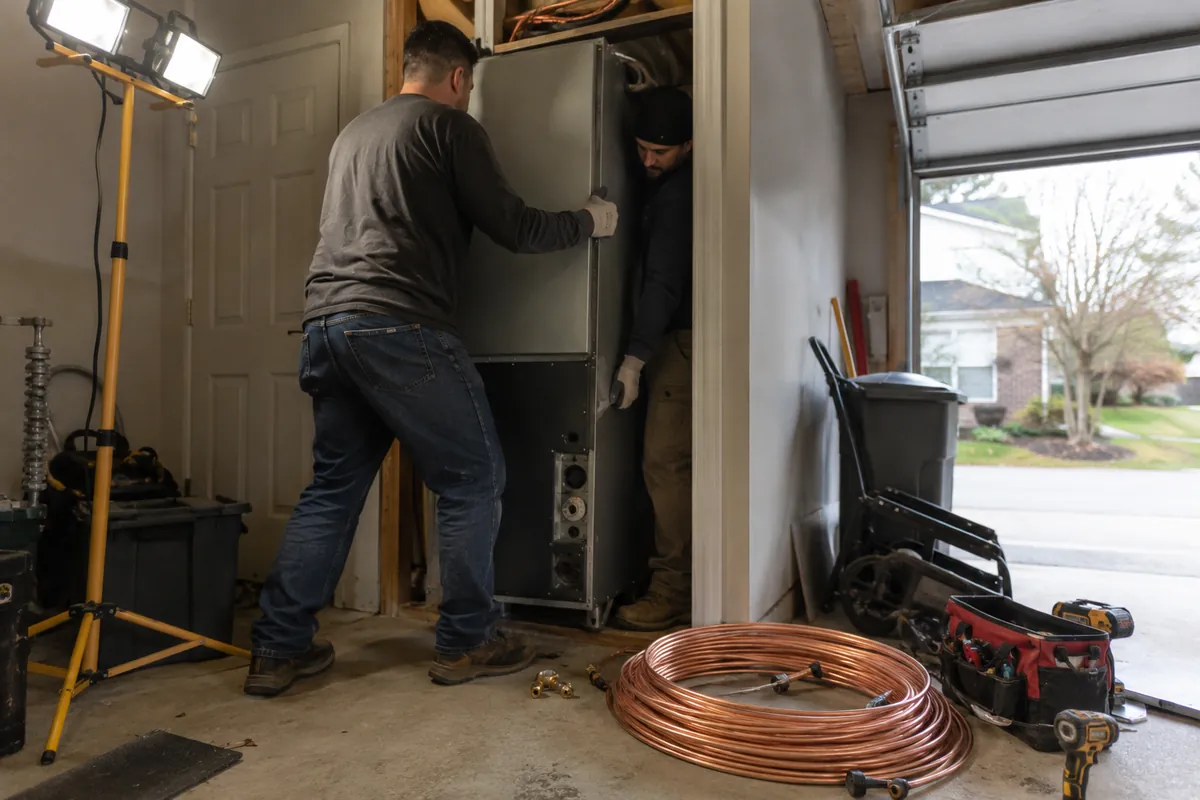
In twelve years of reading homeowner contracts and warranty claims, the document that produces the most confusion is not the warranty agreement. It is the HVAC installation quote. I have watched homeowners pay $7,800 for a job that should have cost $5,400, and I have watched homeowners reject an $8,200 quote that was actually fair while accepting a $5,900 quote that hid $3,000 in change orders. The difference between the two was not the homeowner's diligence. It was the contractor's willingness to itemize.
This is what an honest central AC installation actually costs in 2026, and the six line items that separate a real quote from a placeholder.
The honest range for 2026
| Line item | 2026 cost range | What it covers / why it hides |
|---|---|---|
| 1. Equipment (condenser + air handler / coil) | $2,800 to $5,200 | Goodman ~$2,800, Carrier ~$4,200, Trane $4,600-$5,200 |
| 2. Labor (2-person crew, 6-10 hours) | $1,200 to $2,400 | Roughly $80 to $200 per hour per tech |
| 3. Permits + code-compliance work | $75 to $2,200 | Permit $75-$400; triggered code updates $400-$1,800 |
| 4. Refrigerant line set + recovery | $150 to $1,200 | Reuse saves $400-$800; EPA-certified recovery $150-$400 |
| 5. Electrical (circuit / disconnect) | $400 to $3,500 | New circuit $400-$900; panel upgrade $1,800-$3,500 |
| 6. Removal + lawful disposal | $150 to $400 | Haul-away of old equipment, sometimes buried in labor |
| Total all-in, typical single-family home | $5,500 to $9,000 | In-kind 3-ton 14 SEER2 replacement ~$6,400-$6,900 |
| First-time install (no existing ductwork) | add $3,000 to $5,500 | New duct runs, returns, and trunk lines |
*Line-item ranges reflect 2026 U.S. contractor pricing. Refrigerant recovery is governed by the EPA Section 608 regulations; efficiency-tier context per ENERGY STAR. Market figures cross-checked against 2026 cost surveys from Angi and HomeGuide. Panel upgrades should be quoted separately by a licensed electrician. Confirm current pricing with three itemized local bids.
A central air conditioning installation in the United States runs $5,500 to $9,000 all-in for a typical single-family home this year. That figure assumes a 2.5 to 3.5 ton system, a 14 to 16 SEER efficiency tier, and an existing forced-air duct system that does not require major rework.
The variation inside that range is real, not random. A homeowner in Phoenix replacing a failing 3-ton unit in a 1,800 square foot single-story will land at the lower end. A homeowner in Boston installing central air for the first time in a two-story 1920s house with no existing ductwork will land at the upper end or beyond. The work involved is different. The honest contractor will explain why. The dishonest one will not.
For reference, the national median for an in-kind 3-ton 14 SEER replacement is sitting at $6,400 to $6,900 installed as of spring 2026. New installations into homes without existing ductwork add $3,000 to $5,500 in duct work alone. Heat pump installations rather than straight central AC add $1,000 to $2,500 on top of the base figure.
Line item one: equipment cost
The condenser and air handler are the line item homeowners focus on most. They are also the line item where comparison shopping actually works, because brand and model numbers are checkable.
A 3-ton Goodman GSXC18 condenser pairs with an air handler for roughly $2,800 in equipment cost at distributor pricing. A 3-ton Carrier 24ACC6 condenser with matching air handler runs roughly $4,200. A 3-ton Trane XL18i system runs $4,600 to $5,200. The premium brands cost more, last marginally longer on average, and command better resale.
Ask any contractor to write the make, model, and tonnage on the quote. If they refuse, they are protecting markup. A legitimate quote names the exact equipment so you can verify the wholesale price within $200 to $400 by calling any HVAC supply house.
Line item two: labor
Labor for a central AC installation runs $1,200 to $2,400 depending on regional rates and job complexity. The job typically takes a two-person crew six to ten hours. That math suggests $80 to $200 per hour per technician, which lines up with HVAC labor rates in most markets.
The labor figure should appear separately from equipment. Quotes that bundle labor into the equipment line are concealing the markup. If the equipment line reads $7,800 with no labor breakout, the contractor is buying a $4,000 system, paying $1,400 in labor, and pocketing $2,400 as undisclosed margin. That margin may be fair. The homeowner deserves the chance to evaluate it.
Line item three: permits and code compliance
Most municipalities require a mechanical permit for HVAC installation. Permit fees run $75 to $400 depending on jurisdiction. The honest quote lists this as a separate line item, names the jurisdiction, and confirms whether the contractor pulls the permit or whether the homeowner does.
Code compliance work is where the larger numbers hide. Replacing a 20-year-old central AC unit often triggers code updates the original installation predated. New refrigerant line sets, updated disconnect boxes, condensate handling, electrical service upgrades, and sometimes new air handler platforms. These code-driven additions can run $400 to $1,800 on an otherwise straightforward replacement.
A contractor who shows up to bid and does not mention permits at all is planning to skip them. That is a problem when you eventually sell the house and the buyer's inspector flags the unpermitted work.
> Before you sign anything, get itemized written quotes from at least three local HVAC contractors. Local HVAC Advisor connects homeowners with licensed installers in their zip code. Compare bids line by line, not bottom line to bottom line.
Line item four: refrigerant lines and recovery
The line set is the copper tubing that carries refrigerant between the outdoor condenser and the indoor air handler. If the existing line set is in good condition, it can often be reused, saving $400 to $800. If it is corroded, kinked, or sized wrong for the new unit, it needs replacement.
Refrigerant recovery is a separate line. When the old system is removed, the refrigerant must be captured by EPA-certified technicians using approved recovery equipment, a requirement laid out in the EPA's Section 608 refrigerant regulations. R-22 recovery is non-trivial in 2026, because the refrigerant is increasingly valuable on the recovered market and the certification requirements are stricter than they were a decade ago. Expect $150 to $400 for recovery, depending on the refrigerant type and the volume.
The new refrigerant charge is included with the new equipment. Quotes that itemize "refrigerant" as a separate post-installation line item are double-billing.
Line item five: electrical work
A central AC unit needs a dedicated 240V circuit, an outdoor disconnect, and properly sized wire from the panel. Replacements that match the previous unit's amperage typically reuse the existing circuit. Upgrades to higher-capacity units or first-time installations require a new circuit run.
A new dedicated circuit including the disconnect box, conduit, wire, and connection to a panel that has capacity runs $400 to $900. A panel upgrade to add capacity runs $1,800 to $3,500 and should appear as a separate quote, ideally from a licensed electrician rather than the HVAC contractor.
Watch for "electrical work" appearing as a one-line $1,200 figure with no detail. The honest version separates disconnect, wire run, and any panel work. The dishonest version uses electrical work as a place to bury margin.
Line item six: removal and disposal
The old condenser, air handler, and line set need to leave the property. Disposal fees and refrigerant recovery from the old equipment run $150 to $400. Some contractors include this in labor. Some itemize it. Some quietly skip the disposal step and leave the old equipment for the homeowner to handle, which is a violation of waste disposal regulations in most jurisdictions and a way to save themselves money at your expense.
Confirm in writing that the contractor handles haul-away and lawful disposal. The line item should appear. If the contractor says "we take care of it" but does not put it in writing, they may take care of it by dumping it.
The financing markup nobody discusses
Many HVAC contractors offer financing through partners like Synchrony, GreenSky, or Service Finance. The financing is usually structured as zero or low interest for a promotional period, with high deferred interest if not paid in full by the deadline.
The contractor pays a fee to the finance company, typically 5 to 10 percent of the financed amount, and recovers it in the quote. A $7,200 cash quote may become a $7,800 financed quote for the same job. This is not illegal. It is also not always disclosed. Ask whether the quote price changes based on payment method. Many will adjust downward 4 to 6 percent for cash, check, or credit card without finance terms.
What to do with this information
The first move is not to choose a contractor. It is to get three written quotes that each separate the six line items above. Quotes that itemize are quotes you can compare. Quotes that bundle are quotes that hide.
> Get three itemized bids before signing. Local HVAC Advisor connects homeowners with vetted local installers. The service is free to the homeowner.
The second move is to read the quotes against each other, not against your budget. The cheapest bid is rarely the right answer in HVAC installation. The most expensive bid is rarely the right answer either. The right answer is usually the middle bid from the contractor whose itemization is the most transparent.
The third move, if the budget is tight, is to negotiate scope, not price. A 14 SEER unit instead of a 16 SEER unit saves $400 to $900 and is the right choice for a homeowner who plans to move within five years. Reusing an existing line set in good condition saves $400 to $800. Holding off on the panel upgrade if the existing panel has capacity saves $1,800 to $3,500. Scope concessions are honest. Price concessions on bundled quotes usually mean the contractor is cutting corners they will not name.
The warranty intersection
A new central AC installation is the moment to think about extended warranty coverage. Manufacturer warranties on residential central AC typically run 5 to 10 years on parts and 1 year on labor, with the longer coverage requiring product registration within 60 to 90 days of installation. Failure to register costs homeowners thousands when a major failure happens in year four. Register every product within the first month and keep the confirmation email.
For homeowners considering a third-party home warranty after installation, the standard waiting period (typically 30 days) and the pre-existing condition language both work against a fresh installation if a failure occurs within the first warranty cycle. The cleanest play is to defer third-party coverage until year three of the unit's life and let the manufacturer warranty handle the early years.
Frequently Asked Questions
How much does it cost to install central air in 2026?
A central AC installation runs $5,500 to $9,000 all-in for a typical single-family home with existing forced-air ductwork. An in-kind 3-ton 14 SEER replacement sits around $6,400 to $6,900 installed as of spring 2026. First-time installs into homes without ductwork add $3,000 to $5,500 in duct work alone.
Why are central AC quotes so different from each other?
Because contractors itemize differently, not because the work differs that much. Honest quotes break out equipment, labor, permits, line set, electrical, and disposal as separate lines. Bundled quotes hide markup inside a single number, which is why a $5,900 quote can end up costing more than an itemized $8,200 one once change orders land.
What SEER rating should I choose?
For a homeowner planning to move within five years, a 14 SEER unit instead of 16 SEER saves $400 to $900 up front and is usually the right call. Higher SEER pays back through lower energy bills over a long ownership horizon. The Energy Star central air conditioner guidance explains how efficiency tiers affect operating cost.
Does a home warranty cover central AC installation?
No. A home warranty covers repair or replacement of systems that fail during the policy term, not the cost of a brand-new installation. New units are also subject to the warranty's 30-day waiting period and pre-existing condition language, so deferring third-party coverage until year three of the unit's life is usually the cleaner play.
Do I need a permit to install central air?
Most municipalities require a mechanical permit for HVAC installation, with fees of $75 to $400 depending on jurisdiction. A contractor who never mentions permits is likely planning to skip them, which becomes a problem when a buyer's inspector flags unpermitted work at sale. Confirm in writing who pulls the permit.
The closer
A central AC installation in 2026 will run $5,500 to $9,000 for a typical home. The dollar figure that matters is not the bottom line on the quote. It is the bottom line on three quotes, with each itemizing equipment, labor, permits, line set work, electrical, and disposal. The contractor who shows you all six numbers without being asked is the contractor worth hiring.
> If you are gathering quotes this week, start with three. Local HVAC Advisor will connect you with licensed installers serving your zip code. The match is free. The quotes are not binding. Comparison is the only protection a homeowner has on a five-figure purchase.