Furnace Replacement vs Repair in 2026: When the 50 Percent Rule Tips
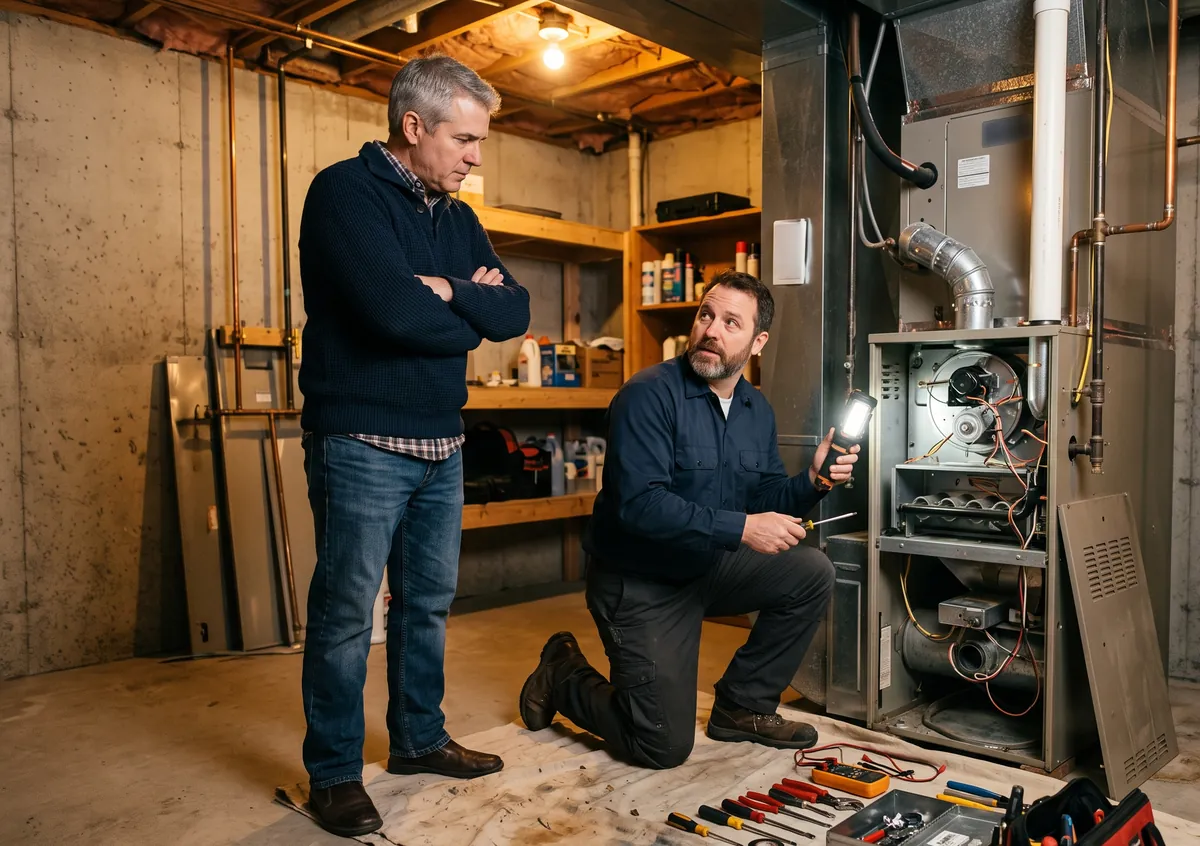
Furnace replacement near me: The adjuster-side answer from twelve years inside the claims process.
The furnace repair-or-replace decision is the most commonly mismanaged home mechanical purchase I documented during twelve years in warranty claims. Homeowners either replace too early (chasing efficiency gains that take 14 years to pay back) or repair too long (sinking $4,000 across three service calls into a unit worth $1,200 in residual life). Both errors cost real money.
The decision rule has been around since the 1980s, and it still works in 2026. Here is the math, current pricing, the AFUE numbers that move the answer, and the contractor sales tactics that distort it.
The honest cost range in 2026
| Furnace job (2026) | Installed or repair cost | Repair-or-replace signal |
|---|---|---|
| Replace: 80k BTU, 80% AFUE Goodman | $3,800 to $4,800 | Budget baseline, mild climates |
| Replace: 80k BTU, 96% AFUE Goodman | $4,500 to $5,800 | Mid-tier high-efficiency (the 50% benchmark) |
| Replace: 80k BTU, 96% AFUE Carrier / Trane | $5,800 to $7,500 | Premium brand |
| Replace: 100k BTU, 96% AFUE premium | $6,800 to $8,800 | Large or cold-climate home |
| Repair: ignitor or flame sensor | $200 to $400 | Repair |
| Repair: inducer motor | $500 to $900 | Repair if under ~12 years old |
| Repair: blower motor | $500 to $1,100 | Repair |
| Repair: control board | $400 to $900 | Repair |
| Repair: gas valve | $400 to $800 | Repair |
| Repair: heat exchanger | $1,500 to $3,500 | Replacement decision point (safety) |
| 50% rule threshold (vs ~$5,800 replacement) | repair above ~$2,900 | At or above this, the math favors replacing |
*Installed and repair ranges reflect 2026 U.S. pricing. Efficiency tiers and regional AFUE minimums per ENERGY STAR; heat-pump and efficiency tax-credit context per the U.S. Department of Energy. Market figures cross-checked against 2026 cost surveys from HomeGuide and Angi. Apply the age adjustment for units past 10 years and confirm current pricing with written local quotes.
A high-efficiency gas furnace installed in a residential single-family home this year runs $4,500 to $7,500. The variation depends on tonnage (60,000 to 100,000 BTU for typical homes), AFUE rating (80 percent to 96 percent), brand, and regional labor rates.
Specific 2026 figures for in-kind replacements:
- 80,000 BTU 80 percent AFUE Goodman: $3,800 to $4,800 installed
- 80,000 BTU 96 percent AFUE Goodman: $4,500 to $5,800 installed
- 80,000 BTU 96 percent AFUE Carrier or Trane: $5,800 to $7,500 installed
- 100,000 BTU 96 percent AFUE premium brand: $6,800 to $8,800 installed
These numbers assume an existing furnace in the same location with usable gas line, electrical, and venting. Conversions from 80 percent to 96 percent require new venting (PVC sidewall instead of metal flue), which adds $400 to $900. Conversions from gas to heat pump add $2,000 to $4,500 and shift the analysis substantially.
Repair costs in 2026 cluster around predictable failures:
- Ignitor or flame sensor: $200 to $400
- Inducer motor: $500 to $900
- Blower motor: $500 to $1,100
- Control board: $400 to $900
- Heat exchanger: $1,500 to $3,500 (and the decision point for replacement)
- Gas valve: $400 to $800
The 50 percent rule
The rule: if a single repair costs more than 50 percent of the cost to replace the unit with a comparable new one, the math favors replacement. The rule is conservative. Some HVAC professionals argue for a 33 percent threshold on units more than 15 years old. The 50 percent line is the safe one for homeowners not under emergency pressure.
Applied to a typical home in 2026:
- Replacement cost (comparable mid-tier 96 percent AFUE): roughly $5,800
- 50 percent threshold: $2,900
- Repairs at $2,900 or higher: replace
- Repairs below $2,900: repair, with caveats below
The caveats narrow the rule. A 7-year-old furnace with a $1,400 inducer motor failure is repaired without hesitation. A 17-year-old furnace with a $1,400 inducer motor failure is replaced, because the next failure is months away and the unit is approaching the end of useful life regardless.
The age-adjusted rule: subtract one year of useful life for every year the unit is past 10 years old. A 14-year-old furnace with a $2,000 repair is closer to a replacement than a 10-year-old furnace with the same repair, because the residual life remaining on the repaired unit is roughly 4 to 6 years rather than 8 to 10.
The AFUE math nobody runs
AFUE, the Annual Fuel Utilization Efficiency rating, measures what percentage of fuel burned actually heats the house versus exiting through the vent. An 80 percent AFUE furnace wastes 20 percent of every fuel dollar. A 96 percent AFUE furnace wastes 4 percent. The difference shows up on the gas bill. The federal ENERGY STAR furnace guidance details the efficiency tiers and the regional minimums that govern what you can legally install.
The payback math for a 2026 northern home using natural gas:
- Typical winter gas bill on 80 percent AFUE: $1,400 annual
- Same home on 96 percent AFUE: $1,170 annual (16 percent reduction)
- Annual savings: $230
- Replacement cost premium for 96 percent over 80 percent: $1,800 to $2,500
- Payback period: 8 to 11 years
For homes with higher heating loads (large square footage, colder climate, drafty construction), the annual savings climb to $400 to $600 and the payback shortens to 4 to 6 years. For homes in mild climates (Pacific Northwest, southern markets that use gas for occasional heat), the savings are $80 to $150 annual and the payback extends past 15 years, beyond the useful life of the unit.
The decision: if you plan to stay in the home for at least the payback period plus a few years, the AFUE upgrade pays. If you plan to sell within 5 years, the 80 percent AFUE unit is the right choice in most markets, because the resale premium for a high-efficiency furnace is usually less than the installation premium.
The heat pump pivot
In 2026, more contractors are pushing the gas-to-heat-pump conversation, particularly in markets with electrification incentives or solar penetration. The pitch is real, but it deserves scrutiny.
A cold-climate air-source heat pump replacing a gas furnace runs $7,500 to $14,000 installed. Federal tax credits cover up to $2,000 of that, under the terms the Department of Energy lays out for the heat pump and HVAC credits. Some state and utility rebates add $1,000 to $4,500. The net cost to the homeowner can land at $5,000 to $9,500, comparable to a premium gas furnace replacement.
The operating cost analysis depends on local electricity rates versus natural gas rates and the heat pump's cold-weather performance. In markets where electricity is cheap and natural gas is expensive (Pacific Northwest, parts of New England), heat pumps win on operating cost. In markets where natural gas is cheap and electricity is expensive (Midwest gas-producing states), gas furnaces still win.
The contractor pushing heat pump replacement on a 12-year-old gas furnace failure deserves a follow-up question: what is the cost-per-million-BTU comparison for this specific zip code? An honest answer involves looking up the EIA average electricity rate, the local gas utility's rate schedule, and the heat pump's HSPF rating. A vague answer means the contractor is making a guess or chasing a margin.
> Before authorizing any furnace work over $1,500, get a second opinion. Local HVAC Advisor connects homeowners with multiple licensed installers so the repair-or-replace question has more than one voice answering.
The heat exchanger conversation
The heat exchanger is the part of the furnace that separates combustion gases from the air that circulates through the house. A cracked heat exchanger is a safety issue, because cracks allow carbon monoxide to enter the airstream. Most manufacturer warranties cover heat exchangers for 20 years on residential furnaces, often lifetime on premium tiers.
A heat exchanger failure under warranty: the part is free, the labor is $800 to $1,500, and replacement is the obvious answer if the unit is under 12 years old.
A heat exchanger failure out of warranty, or on an older unit: total cost is $1,500 to $3,500, and the 50 percent rule almost always tips toward replacement. A 14-year-old furnace with a cracked heat exchanger is rarely repaired.
The contractor who shows the homeowner the actual crack with a borescope camera is honest. The contractor who declares a "suspected hairline crack" without visual evidence and recommends replacement is selling. Ask to see the crack on the camera screen.
The supply chain reality in 2026
Furnace parts availability has improved through 2025 and into 2026 after the supply disruptions of 2021 to 2023. Lead times on common parts are back to 1 to 3 days from regional warehouses. Replacement equipment lead times for stock SKUs are 1 to 5 days. Special orders for high-efficiency or premium-brand units run 1 to 3 weeks.
The premium for emergency next-day installation runs 15 to 25 percent over scheduled installation prices. In the heart of winter, this premium is justified. In late spring through early fall, scheduling 2 to 4 weeks out saves real money on a planned furnace replacement.
The contract-clause angle
Most home warranty contracts cover furnaces with caps of $1,500 to $3,000 per claim. The cap matters because heat exchanger failures and full unit replacements often exceed the cap. The homeowner is responsible for the difference.
Pre-existing condition exclusions: the most common denial reason on first-year furnace claims. A furnace that was making noise or cycling oddly before the warranty effective date is denied when it fails in month two. Documentation of a pre-purchase inspection or maintenance receipt is the homeowner's defense.
Age clauses: some warranty contracts exclude coverage for units past a certain age, typically 15 to 20 years. A 19-year-old furnace under a contract with an 18-year exclusion is uncovered when it fails. Read the age clause before assuming coverage applies.
What to do when the failure happens
The decision sequence for a furnace failure:
- Get a written diagnosis from a licensed technician, including specific failed component and quoted repair cost.
- Compare repair cost to 50 percent of replacement cost for a comparable new unit.
- Apply the age adjustment if the unit is over 10 years old.
- If repair is the answer, schedule it. If replacement is the answer, get three quotes before signing.
- Verify warranty coverage if the unit is under manufacturer warranty.
- Confirm whether the homeowner's third-party warranty applies and what cap or exclusion is in play.
> Get three written quotes before signing on a replacement. Local HVAC Advisor connects homeowners with vetted installers, and three quotes is the floor, not the ceiling.
Frequently Asked Questions
When should I replace my furnace instead of repairing it?
Use the 50 percent rule: if a single repair costs more than half the price of a comparable new unit, replacement is the better math. On a mid-tier 96 percent AFUE furnace costing about $5,800 to install, that threshold is roughly $2,900. Adjust for age by subtracting one year of useful life for every year the unit is past 10, so an older furnace tips toward replacement at a lower repair cost.
How much does a furnace replacement cost in 2026?
A high-efficiency gas furnace installed in a single-family home runs $4,500 to $7,500, depending on tonnage, AFUE rating, brand, and labor rates. A budget 80 percent AFUE Goodman lands around $3,800 to $4,800, while a premium 100,000 BTU 96 percent unit can reach $6,800 to $8,800. Converting from 80 to 96 percent adds $400 to $900 for new venting.
Is a high-efficiency furnace worth the extra cost?
It depends on your climate and how long you will stay. In a cold northern home, a 96 percent AFUE unit saves roughly $230 a year over an 80 percent model, a payback of 8 to 11 years on the $1,800 to $2,500 price premium. In mild climates the savings shrink to $80 to $150 a year and payback can exceed the unit's useful life. If you plan to sell within five years, the 80 percent unit is usually the better buy.
Does a cracked heat exchanger mean I need a new furnace?
Often, but not always. A cracked heat exchanger is a safety issue because it can leak carbon monoxide into the airstream. If the unit is under 12 years old and the part is covered by a manufacturer warranty, replacing the exchanger (labor of $800 to $1,500) is reasonable. Out of warranty or on a unit past 14 years, the $1,500 to $3,500 total cost usually tips the 50 percent rule toward full replacement. Always ask to see the crack on the borescope camera.
Will a home warranty pay for furnace replacement?
Only up to its cap, which typically runs $1,500 to $3,000 per claim, well below the cost of a full replacement or a heat exchanger job. You pay the difference. First-year claims are also frequently denied under the pre-existing condition clause, so keep a pre-purchase inspection or maintenance receipt as documentation. Check the contract's age clause too, since some exclude units past 15 to 20 years.
The closer
The repair-or-replace question has a math answer, and the math has not changed much in 40 years. What changes is the cost of replacement, the AFUE math on the savings side, the parts availability on the supply side, and the contractor incentives that distort the recommendation. The homeowner who runs the 50 percent rule against the age adjustment makes the same decision the warranty industry makes when it evaluates whether to deny or pay.
The contractor who explains the math without pushing for the higher-margin option is the contractor worth hiring. The contractor who recommends replacement on a 5-year-old furnace with a $400 ignitor failure is the contractor to politely thank and not call back.
> If your furnace failed this week and you need quotes, start with three. Local HVAC Advisor will match you with licensed installers in your zip code. The service is free. The quotes are written. Comparison is what protects a five-figure decision.